Sunday, 6 December 2015

Clojure X 2015

Clojure eXchange 2015 has just finished and I must say that I thoroughly enjoyed it. The feature packed two days of the conference has passed by in a blur.  I've been to other IT conferences before but this was my first one entirely devoted to Clojure.  It was a great forum to meet kindred spirits as well as the added bonus of meeting some of the authors of open-sourced Clojure projects.


It was also gratifying that as well as the comprehensive and growing Clojure ecosystem, one could witness also the large number of real world applications written in Clojure. This is a testament to Clojure's burgeoning maturity as a programming language.

I'm pleased to announce the majority of talks are already available on Skillsmatter's website.

All of the talks were excellent. My particular favourites were Bozhidar Batsov talk on Cider. He's one of the authors of Cider and gave an informative but also very humorous talk on the some of the new features of Cider, an Emacs editor for Clojure. I've never used Emacs in anger but I'm encouraged to try and learn because of Bodzhidar's enthusiasm.

I was also impressed by J. Pablo Fernández talk on What is a Macro?. This highlighted one of Clojure's core strengths as it showed how easy it was to add new language features by the use of macros. He demonstrated it by an example of using JUnit assertions. Typically in an object-orientated language such as Java if you need to add assertions for new types it results in numerous overloaded methods which in essence are fundamentally doing the same thing. J. Pablo showed how this could be achieved by a single macro. The behaviour is captured in one place but the use can be used by several types. This showed the inherent power of macros. Something for me to investigate further.


Malcolm Sparks presentation on Yada was also very interesting. This is a Restful Web Service API for Clojure supporting all REST maturity levels. Having used predominately Java frameworks,  I was impressed by the succinctness of the API, where most of the plumbing or infrastructure code is hidden so one can concentrate on solving the business problem at hand.

I'm not a front-end developer but I was still intrigued by Kris Jenkins presentation on using ClojureScript: Architecting for Scale. Kris showed how to forgo the use of MVC pattern and how to write simple page applications so incidental complexity is kept as a minimum. This is something to adopt no matter what type of programming you do. The pattern he described as been released as new library Petrol in which the use of reactive patterns becomes paramount

Looking forward to Clojure 2016 already.

Thanks to Chris Howe-Jones for organizing a great event.

Monday, 12 October 2015

BDD with Cucumber School


I have been a BDD practitioner for a few years, a combination of self-learning and attending various user groups and getting useful feedback from my peers.  BDD is something you pick up gradually and gets better with practice. My personal experience when starting to use BDD was that it can be a form of information overload because one is not sure where to start. With newcomers, sometimes the focus is on the tools rather than the extracting and understand the actual behaviour of the business. Some people think they've practised BDD if they just write scenarios and automate their examples, a tick box exercise. But BDD is and should be larger than that.

I was fortunate to be asked to peer review a set of online training videos from the Cucumber School, the team who originally created Cucumber. The course assumes no prior knowledge in BDD concepts or the use of Cucumber. Every video has a range of exercises that you can perform after watching to reinforce your learning.  This is great as it means that the videos are not a dry exercise in memory retention but rather an impetus for self-learning.

I was gratified to see that the initial lesson were geared towards fleshing out behaviour via conversations or examples rather than diving straight into the tool. This is achieved by the need for distinct user roles in defining and refining those examples.


A team is usually built of different disciplines such as developers, testers and a business representative such as a product owner. What was hammered home during the lessons was the need for continual collaboration  and communication between all team members so that the specifications constructed were effective and garnered common understanding.

An exploration of the Gherkin syntax was covered. Gherkin is a business readable DSL that describes the behaviour of your software without detailing its implementation. You can think of this as a form of standardization in how your scenarios should be constructed. Cucumber School gave an excellent explanation on Gherkin and how to tailor scenarios effectively.


Later lessons then dived into the actual Cucumber tool itself, right from setting up the IDE, generating skeleton code from scenarios and then fleshing out the implementation. This was all performed in an iterative manner.  I found this extremely beneficial because it demonstrated how to build up the executable part of a specification gradually.  The code was incrementally built to support the individual steps of a Gherkin scenario. The re-use of step code across similar steps was a fundamental point through the judicious use of regular expressions. Again no former knowledge of regular expressions was expected.  A beginner could still pick up the salient points and write their own expressions by the end of the lesson.  Emphasis was also placed on the readability of scenarios so that they were kept relevant to the business and their intent was clear.

When devising steps, another point conveyed that the steps should really be a thin veneer across a domain model. This is important because the domain model should be able to exist independently of the BDD framework. TDD was heavily enforced to flesh out the model that the scenarios suggested. Constant refinement of scenarios and unit tests was encouraged. A great point was made about listening to tests because they were a reflection on how well the domain was understood and also on how well that domain or scenario could be tested.  Removal of whole scenarios was also encouraged if those scenarios no longer had any value.  A scenario may have been written which in retrospect duplicated  or was a simply a generalization of another scenario which captured that behavior more succinctly. In that case, the scenario should be pruned.  Refactoring of code but also refactoring of the scenarios themselves was a salient aspect of the training. For instance, some scenarios were better described with the use of tables. This was all to keep the scenarios understandable and focused. Another point that was driven home was to strive to get the scenarios described at the right level of detail. Enough for the feature to be adequately described but not so little that the scenario became too vague or not too much detail so that the implementation did seep into the scenario.


A practice which I intend to follow is Example Mapping. This is  a great tool during the inception phase of a project when one is trying to understand the problem to solve whilst also taking note of those questions we still have to answer. Example Mapping  is a technique to break stories into rules and examples. This is a great example of Deliberate Discovery where we try to get feedback for the application we're about to build before we actually write any code. By focusing on examples, we get a feel on how the application will behave before its existence.


I like that a holistic view of development was portrayed in the sense that BDD and TDD were not considered disparate, but practices to be followed at different levels of granularity. A great phrase that resonated with me was that BDD enforced outside-in development.

BDD ensures you're building the right thing, but TDD ensures you're building the thing right. 


Also emphasized that BDD encourages different types of testing should be covered at different levels.  For instance, there should be a plethora of TDD tests at the bottom of the scale, then system or integration tests to tie the domains together with BDD or scenario level tests above that.   At the top should exist exploratory testing. What sometimes happens is that although automation is in place, there is still a substantial amount manual testing undertook, which is both laborious, slow to complete and error prone.


BDD encourages that the higher up the pyramid one goes, the less testing there should be. All of the testing permutations happen lower down so that as we rise, although the tests become fewer, they become more important.


The final lessons touched upon testing the domain model from a web-front-end.  Automation was achieved via the use of Selenium.  I'm not a front-end developer, but the example shown was easily understandable and a great base to build upon for future front-end testing.

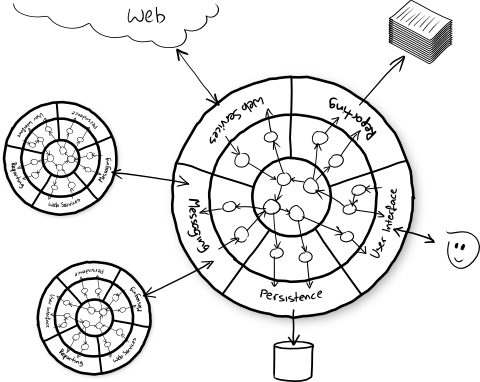
It was great to see the hexagonal design pattern being promoted to facilitate easy swapping of testing the domain directly or from the front-end.  This pattern also known as a port and adapters allows one to separate the core business logic from anything that touches the outside world such as front-ends or databases. This enables the domain to be tested either directly or from a browser. It was a great example of front end testing but also defining scenarios so that the domain was separate from any front-end concerns.


(Reprinted from Nat Pryce's Ports and Adapters Architecture)

As I proceeded through the lessons, any questions I had on BDD on testing or the right way to approach devising a domain model were answered by later lessons.  This was a great way to learn and for those points to stick in the mind.

A lot of people still think BDD is a tool and is only about testing. For a long time, I was one of those people too. I believe BDD is still poorly understood and frequently misappropriated. But following the Cucumber School lessons, I think a lot of the misnomers of BDD will be eradicated. At the end of the course I feel I've gained several approaches to finding solutions to problems in new ways.

So in conclusion,
  • The videos and related exercises are excellent in describing the benefits of developing software following a BDD approach
  • I liked that the modus operandi was to adopt a reactive approach rather than trying to get everything correct the first time round.  Recognizing shortcomings in scenarios or code and test smells led to feedback loops in which those were corrected later on. I think this was a great point to take away and remember.
  • I liked how BDD was presented as complimentary to other practices or development techniques such as TDD or DDD. 
  • The lessons are very good for newcomers but experienced practitioners will also find useful information. I've certainly learnt some practices I wasn't aware of, which I'll carry into my daily work. The series of lessons from Cucumber School come highly recommended.


Sunday, 9 June 2013

Code as you would order a burger


Recently during my work, I came across some code where the paradigm Tell Don't Ask came into play. You sometimes see code written that's not really using OO to its full strengths and still is of a procedural stance. There's often frequent examples where an object asks other objects for data and then does something with it. This is not really OO even though you may still be using other aspects of OO such as encapsulation, inheritance or polymorphism. It's still asking for data whereas the real value-add for OO is message passing or the behaviour of the objects rather than the data they may contain. I've come to understand this implicitly via the usage of mocks during testing. The use of mocks results in code that better follows the 'Tell, Don't Ask paradigm. One of the originators of mock objects noted that:

The trigger for our original discovery of the technique was when John Nolan set the challenge of writing code without getters. Getters expose implementation, which increases coupling between objects and allows responsibilities to be left in the wrong module. Avoiding getters forces an emphasis on object behaviour, rather than state, which is one of the characteristics of Responsibility- Driven Design - Tim McKinnon

Once I came over this mental hurdle, I found I wasn't primarily concerned with the data passed between the objects but really that the appropriate methods calls or methods (messages) between objects were observed. I used the Mockito mocking library and I find the most of my tests are interaction tests i.e. verifying that methods calls were made in the manner expected. State-based testing is still important but at the right place. This got me thinking about objects in terms of Alan Kay's emphasis on message passing http://c2.com/cgi/wiki?AlanKaysDefinitionOfObjectOriented. The following examples illustrate why telling an object to do something rather than asking it for its data is better.

I work a lot with enterprise integration and one of the examples that illustrates this point is message concatenation. During conversion from an internal message to one that that is supported by an external protocol. Dependent on whether a message is concatenated or not, then the message may be decorated with extra parameters to indicate that it is a multipart message rather than a single message.

In this example, the extra metadata parameters that get added are:
  • The message reference for the multipart message
  • The part number of the message
  • Total number of parts for the message
Implementation using "Ask" approach
A factory was used to create a map of parameters for message concatenation

Loading ....

The protocol converter that used this information was coded like this:

Loading ....


This bad for several reasons:
  • The MultipartMessageParameterFactory returns an abstract datatype. In this case a map, so users of this class have to know what keys to pull out the data. If this approach really must be followed, a domain object to hold the multipart parameters would be better, maybe a simple POJO with accessors for the different parameters.
  • The main problem with this approach is it results in Inappropriate Intimacy. The user is asking for some data and then assembling that data thereafter. The lookup keys for the map are made public presumably to mistakenly enforce DRY principles for magic strings within a unit test.
  • This class could become better by passing in the parameter factory in the constructor so it can be mocked. In this way, the unit test for this class will be simpler although it remains too complicated.

Implementation using "Tell" approach

The Tell is all about telling an object to perform some piece of work on your behalf rather than asking that object for data and then doing the work yourself. In the previous example, the protocol converter asked another object for the message concatenation info and then added those parts itself to the message. In the following example, we ask another object to do this bit of work for us. Firstly we introduce a domain object to replace the map use for the multipart parameters:
Loading ....
The factory now returns this POJO instead of the naked ADT:
Loading ....
Now the converter asks another object, MultiPartMessageUpdater, to do the message updating:
Loading ....
The code for updating the message is pushed into its own class. As well as enforcing the single responsibility principle, it also endorses the command and query separation principle so that the retrieval of the actual parameters (query) is separated from the addition of those parameters to the message itself (command).
Loading ....
As a byproduct, the test for the converter becomes very simple. Beforehand we would have to test every permutation of concatenated parameters. Now because code has been pushed to their logical place the test boils down to just testing the following behaviour:
  • Message should be updated if message is part of a multipart message
  • Message should be untouched if message is just a single message

Loading ....
The permutations for those 3 message parameters are pushed to where it should be namely the test for the MultipartMessageParameterFactory. Each test then tests what it should instead of testing the unit and all of its dependencies' behaviour at the same time resulting in a combinatorial explosion of test methods making the test unclear.

Conclusion

  • We've now got a class which now asks other classes do work i.e. operation requests instead of asking for data and doing the work ourselves.
  • By following this approach the single responsibility principle naturally falls out. Each class performs a single well, understood operation and only that operation. This makes those classes loosely coupled and become candidates for reuse in different contexts if needed.
  • Unit tests have become clearer and focused as they only testing a single object rather than a multitude. If you notice I've endeavoured to use constructor injection for any dependencies. This makes the testing of classes easier as I can mock out any external dependencies.
I remember this paradigm by thinking what you would do if you ordered a burger in McDonalds. Would you ask the server for two sliced bun halves, some mayo, lettuce, a hamburger, cheese and tomato sauce or would you just ask for a Big Mac? :D
Links


Wednesday, 25 July 2012

Constructors that do too much


A flaw I've notice frequently in a legacy code base is constructors which are doing too much work. A common anti-pattern is that a configuration is passed into a constructor. This configuration is then perused to find information so that further objects can be constructed in the constructor. I will discuss why I think this is bad practice.

As an example I have a message dispatcher which delegates to a sender object
to send a message to a destination. A dispatcher usually makes a decision on the appropriate destination based on the message. For this example there is only one endpoint. This destination is to be read from the configuration.

So I have an interface for the sender:


and a dispatcher which uses the configuration to build a sender inside its constructor:


The expected usage for the constructor then becomes:

This is bad on several counts:

  • Abstract data type is passed in. There's no indication how this will be used or what it's used for. It's just a bucket of parameters. If possible a specific type should be used in preference to an ADT. It's all about the domain and context. Check out Domain Driven Design  or GOOS touches on this point.
  • Harder to unit test. I have to make sure configuration is correct so that internal objects can be created properly. In my example I've only one object to consider but they may be several. 
  • I can't mock the behaviour of any objects created by the constructor. In essence that behaviour is hard-wired which may be deleterious to testing if that behaviour is using a real resource i.e. socket or database. It turns the unit test into more of an integration test

Use a factory approach


So instead of passing in a configuration, pass in the already constructed objects. A DI framework such as Spring or Guice will assist you in this regard as it's fundamentally what DI is all about. You inject pre-configured objects into other objects rather than building those objects internally.

If you're not using a DI framework (I'm in this situation as it's legacy code) then it's better to pass a factory which builds the object on the fly as a constructor parameter.

To illustrate this:

I can have a factory that produces Sender objects. I've taken the liberty of introducing a generic factory for this purpose. It builds objects of the specified type for a given configuration.


Now I provide an implementation for the Sender:

And to illustrate the point I rewrite the Sender class:


Finally I rewrite the message dispatcher. The constructor now takes objects rather than configuration


And the usage becomes:


This is a lot better:


  • Now the dispatcher only knows about objects. It does not even know a configuration is used.
  • The transformation of a configuration into object is localized in the factory and not spread out across the code base
  • The class becomes trivial to unit test. Instead of worrying about configurations I can simply create a mock Sender and pass that to the dispatcher. In this way I can focus solely on the behaviour of the Dispatcher itself.


Conclusion

Resist the urge to pass around configuration objects and allowing constructors to build new objects. A constructor should ideally be used for assembly only. It's better to just pass pre-configured objects into a constructor. This makes the intention of that constructor clear and makes it easier to unit test the class in question as the colloborators can be mocked easily.

Sunday, 8 July 2012

Don't forget to refactor

Recently I've been a mentor of Test Driven Development to my colleagues. I find it interesting introducing TDD to developers who've never followed the approach and finding what I take for granted having practised TDD for many years.

TDD can be summarized succinctly: 
  • Write a failing test to demonstrate the required behaviour of the code
  • Write code to make test pass

(Thanks to Guido Maliandi for the diagram.)

I find that the last step is often ignored or is not taken as an equally important step by TDD practitioners. TDD detractors will often point to a lack of up front design and this stage is probably the culprit. I concede that if you pay no heed to design in TDD, you'll end up with a poor codebase. i.e. I've got a green bar, now I'll continue with my next test. That's why the refactoring stage is important if not the most important stage.

When you've got a green bar, you have made a step in the right direction but it's not the last step you should take. The presence of a working unit test gives confidence that the code can be refactored. When I perform the refactoring stage, I look for any code smells  I may have introduced. This is an important consideration as I find TDD newbies dither a lot on whether the code they have written is 'perfect'. The initial goal should be to get that green bar. Once you're there, then you can consider other issues during the refactoring stage. 

The refactoring stage should also be a point where you ask questions of your code at a wider scope:

  • Does the code fit into the overall architecture?
  • Does the code achieve non-functional requirements i.e. performance ?
The thing about writing tests before production code is that you end up without complex classes. The test you write forces you not to write a complex test with lots of stubs. As a result you will create small classes with only one responsibility. Your code will be decoupled, flexible and configurable. You don’t have to worry about S.O.L.I.D. principles. They will naturally emerge.

The refactoring stage is an often overlooked stage. Lack of focus on this stage leads to build of code entropy resulting in technical debt that will eventually need to be repaid. It should be kept in mind TDD is not mainly a testing strategy, but a design strategy. The tests written first results in a better decoupled design. A better decoupled design in turn is easier to refactor. A case of positive reinforcement.  The code will also be easier to maintain and add new features should they be needed.

Friday, 4 November 2011

JAX London 2011

As a member of the London Java Community, I was gratified to hear of a Java conference, JAX London, on my own doorstep and eagerly signed up. It had been a while since I've attended a Java conference. I used to be a regular attendee of JavaOne but over the last few years, it has lost its lustre, especially now as it seems to be a bolt-on to Oracle OpenWorld. Maybe that'll change in future.


Day 1:

I eschewed the workshops on Android and JEE6/7 development in favour of talks focused on Spring technology. There were some excellent talks given on the new additions to Spring such as Spring Data as well as the upcoming functionality in the next version of Spring. There were also some good introductions to Spring Batch and Spring Security. A talk was also given on the interoperability of Spring and Scala which was informative on the use of Java DI frameworks with Scala rather than using inherent Scala approaches (see Cake pattern).

The most useful session in my eyes was the round table discussion at the end of the day in which the audience were allowed to ask questions to the Spring creators themselves. This was especially fruitful as you gain those nuggets of wisdom from these experts in their fields which you wouldn't normally get if it wasn't a vis-a-vis conversation.

Day 2:

My second day at the conference was mostly Agile focused. I attended a very good talk on the Scrum Product Backlog by Roman Pichler of which many salient points of advice were offered.

The next talk addressed software quality. The first talk on Software Craftmanship by Sandro Mancuso. This talked reinforced the idea that software development is a craft rather than purely engineering. He extolled the principles of the Software Craftsmanship movement, promoting self-improvement, knowledge share, professionalism, passion and care.  I resisted the urge to jump up from the audience and shout 'Amen brother' but that was what I was thinking. The next talk titled Slow and Dirty by Jason Gorman refuted the notion about that we should release code dirty due to unrealistic deadlines and worry about the clean up later. One of his memorable phrases was 'Anaerobic Software Development'. I'm sure a lot of developers will concur with this sentiment. This describes situations where development teams start projects at an unsustainably fast rate, causing entropy in their code to build up. This causes intense pain after a short while which results in the team having to stop for weeks, maybe months until enough detritus is removed so the project can start moving forward again. If you're lucky that is, sometimes there's so much build up (holding back on the profanity :)), that the project must be dropped entirely and a new one must be started. His guiding principle was that if you care about quality all of the time then you don't get into these situations. Next time a manager, tells you we need something quick and dirty, cut corners on quality, to get something out of door, you should be prepared to push back as much as possible. You're only making a rod for your own back and building technical debt which must be repaid later.

Given my interest in concurrency, the next session I attended was on message passing by Dr Russell Winder who opined (with many interesting, witty and funny anecdotes) about why the shared memory multithreading, the prevailing wisdom of currently popular languages should not be used. Instead they should be replaced by higher level constructs such as Actors, CSP and DataFlow so that issues seen in contemporary approaches are eradicated. He then gave a demonstration with Actors via the GPars library of which he is the author. The 50 minute talk did not allow him to give a fuller treatise of the subject but it has definitely piqued my interest in that library for further investigation.

The last session of the day was giving by Martijn Verburg and Ben Evans on some of the new features of Java 7. They then delivered an open coding session on some of the features of Project Coin. Unfortunately for me, this turned out for me to be a thought experiment as I didn't bring my laptop to the session, although I did get to ask Martijn some questions on some of the new concurrency features in Java 7.

Day 3:

In my previous blog, I opined about whether had Java had reached its peak. I may have to revise my opinion somewhat after two excellent keynotes from James Governor of RedMonk and Simon Ritter of Oracle. The latter reinforced my view that the really interesting stuff will happen in Java 8 with respect to lambdas and modularity. It was also interesting to see Oracle's roadmap for Java in that they intend to release a new version of Java every two years. The roadmap given was up to 2019. Wonder what Java will look like then?

Fredrik Öhrström of Oracle then gave a very informative talk on some of the expected features in Java 8 specifically lambdas, map filter reduce and interface extensions. Following the takeover of Sun by Oracle, there are now two competing JVMs i.e. JRockit and Sun Hotspot. There is now a plan is for JRockit functionality to subsumed into Hotspot VM with the non-enterprise JRockit features to be added later incrementally.

The next lively talk on Performance Tuning resulted in a well known adage, 'Measure don't guess'. The presentation centered on a mal-performing web application. By measuring the throughput and load using different tools such as JMeter, VisualVM and vmstat, they showed how to investigate and eventually find the culprit. One should never shoot in the dark when performance tuning.  A scientific approach should be followed such as baselining your application before any measurements are made so as to ensure that any changes actually lead to an improvement rather than degradation.

I then attended another talk on Java 8 concurrency giving by Martijn Verburg and Ben Evans advocating the use of Java concurrency library rather than relying on outdated constructs such as using synchronized. They also gave an on why parallelism will become more important in the upcoming years.

Changing tack for a few sessions, I then attend Ted Neward NoSQL session. This was a talk on what NoSQL actually meant as there's a lot of ambiguity in the community on this fundamental point. He then compared some of the common NoSQL variants such as db40, Cassandra, MongoDB and the typical situations where they could be used, a point sometimes missed. Use the right tool for the right job. Ted Neward is a great communicator and the session was enlightening in all respects.

The final session of the day was given by LMAX on their Disruptor Pattern. This was very interesting in many ways, as it seemed to go against the grain of previous sessions on concurrency. LMAX is a financial exchange so latency throughout their system is extremely critical. Through empirical evidence they demonstrated that accepted approaches to concurrency were non-performant due to the overhead of dealing with the JVM and JMM. This was especially interesting as being a Java programmer we're shielded from the low level details of the architecture your program is running on and assume that we need not worry about it too much as it's the JVM problem not mine. This is no longer the case. We know have to be increasingly wary of latencies between the processor, the L1, L2 caches etc and the main memory, as well as the JIT assembly code, a mechanical sympathy if you will. Their innovative solution rests on using a lock free ring buffer (the fundamental data structure at the heart of the Disruptor) rather than using the traditional work queue/thread approaches. I've not really given the Disruptor pattern the attention it deserves, as it really is a sea change in how applications could be architectured both from a business logic and data point of view. I will definitely be doing some investigation on this topic. There is a great introduction to this given by Martin Fowler and it's also advantageous that the Disruptor is an open source project.


Last thoughts:

Sadly though there were at least 10 other sessions I would like to have been at. I would have loved to followed Ian Robinson's session on Neo4J as well as attended some of some of the cloud offerings (some former colleagues of mine from Cloudsoft were presenting) but alas the timetable didn't allow me the opportunity. All in all, a feature packed 3 days which ended far too quickly. It's great to meet a lot of kindred spritis who were as passionate about technology as I am. I'm already looking forward to JAX 2012 :).

Wednesday, 12 October 2011

Peak Java?

Has Java peaked? To me the Java 7 release feels like it did when Java 3 came out; some gravy no meat. It's not a ground breaker as the evolution from Java 1.1 to 1.2 or when Java 5 was released. Sure there has been some nice language improvements but for me, Java as a language has pretty much stabilised. These new syntactical changes are just glossing over pain points for which they are ample (although sometimes arduous) workarounds.


The big changes I see in the future in Java 8 are the Java Module System (JSR 277) and Closures (JSR 335). The latter is needed to make Fork/Join more useable. Closures may have made a bigger impact a few years ago, but now with a plethora of other JVM languages, I feel this will no longer be the case.


What's becoming increasingly apparent is the increasing importance of  Java platform. The important thing is not the Java language itself but the JVM.  This acts as a substrate for different languages. Although from above the languages may seem different, it ensures that underneath the covers the the behaviour is consistent.


Some examples of JVM languages which have gained traction over the last few years are:
And we have some new kids on the block:
  • Ceylon, Red Hat's Java competitor
  • CAL, a Haskell-inspired functional programming language.
  • Gosu (programming language), an extensible type-system language compiled to Java bytecode.
Maybe Java has reached its peak. It's certainly looks like it reached its plateau. I'm looking forward to using Java 7 and 8, but for the JVM improvements only. The platform matters more than the language now.


Tuesday, 2 August 2011

Using generics with a fluent API

I've recently worked on an integration project requiring a message API.  It was to be responsible for building messages of various types to be sent on a variety of transports. Each message had numerous parameters but some were only used in particular contexts. This meant that frequently you'd get constructors where some of those parameters had to be set to null to indicate they were not to be used. This is a code smell. One solution would be to use the refactoring 'Introduce parameter object'. This refactoring is used to group parameters together into immutable classes so those parameters have a common context.  This may alleviate the problem somewhat but in practice I found this resulted in several overloaded constructors each with different combinations of parameter objects. I needed another solution.

I've had some success in the past using fluent API with builders. A fluent interface is implemented by using method chaining to relay the instruction context of a subsequent call. My expectation was to create something like:


Some parameters were common to all message types so it made sense to have these in a base class.

The message base class:


and it's associated builder:


I then subclassed the builder class to create the specialized message types. For brevity most parameters have been omitted.

An example of a specialized message class with inherits all the properties of the base class along with its own parameters.


The builder for this class:


However to get the expected usage of:


I've had to subclass all withXXX methods from the Message base class. In this example, it's not too painful as there's only a couple of common parameters but more realistically I could have numerous parameters which means for each specialized subclass I need to override those methods. This approach quickly becomes unwieldy and a maintenance headache. To make sure that method chain returns the correct type I've had to resort to calling the super method and then return the correct type i.e this. Not very good.What I needed was for each subclass to inherit the super class methods implicitly but with the proviso that they return the actual type not the super type.

A solution is to use Self Bound GenericTypes.  Angelika Langer gives a good explanation which she calls the getThis() trick.

The base MessageBuilder class has been changed to use self bound generic types. So for example, instead of hardwiring withId() to return the type of the builder that defines it,  a type parameter B is introduced and  withId() returns B via the abstract self() method. This self method implemented in the subclass to return the concrete type rather than the base type of the builder.  The self-referential definition MessageBuilder<B extends MessageBuilder<B>>  allows the return type of the inherited withId() in RequestBuilder to be RequestBuilder rather than MessageBuilder.


Now all the subclass has to do, in addition to its own fluent methods, is to provide an implementation of the self() method. Job done.


In this way, subclasses for builders only need be concerned with providing fluent methods for the parameters pertinent to that class. They will automatically inherit fluent methods from the super class so no overriding is required and the intent of the class is clearer.  I can build up that message's fluent methods to set the parameters I actually need for that particular context without resorting to long unwieldy parameter lists. Again the intent is clearer. Result !

Thanks to a bit of tinkering, this solution seems elegant and understandable now but as usual with generics it'll be mostly incomprehensible tomorrow :).

Links

Monday, 1 August 2011

A comparison of FDD and Scrum


FDD and Scrum are two examples of agile development methodologies. Agile development tries to avoid the main weakness of "waterfall" by doing iterative development. Each iteration is meant to be short (1-2 weeks) and includes all of the following steps.
  • Gathering user requirements
  • Design and documentation
  • Development
  • Testing
  • Deployment
This guarantees that design errors are discovered at early stages of development. I've had experience on working on projects using both methodologies and it was interesting to compare the salient features of both approaches.  Before the comparison, a short overview of each practice is given.

Feature Driven Development
Feature Driven Development, FDD  is an agile software development methodology by Jeff De Luca and Peter Coad.  It has more formal requirements and steps than Scrum from a development perspective.


FDD consists of five high level activities:
  • Develop an overall domain mode
    • FDD advocates light modelling up front to understand the shape and scope of the application.
  • Build a list of features
    • Team builds a feature list.  Each feature represents 1-10 days worth of effort.  
    • A feature is a small piece of client-valued function expressed in the form: <action> <result> <object> i.e. Calculate the total of a sale
  • Plan by feature
    • Features are then assigned to iterative release cycles.
    • Developers are also assigned to own particular classes identified in the domain model by a chief programmer.
  • Design By Feature (DBF)
    • Feature teams are assigned to a set of features and proceed to the design in detail i.e. sequence diagrams 
  • Build By Feature (BBF)
    • Those teams then carry out the code development and testing of those features.
    • When chief programmer is satisfied then completed features are promoted to the main build.
FDD utilizes chief programmer, inspections, and class ownership. The chief programmers function as team leaders, mentors, and reviewers. While the term chief programmer may suggest micro-management and control, FDD teams stress the collaboration and knowledge sharing roles.


Progress and can be tracked and reported with accuracy by assigning a percentage weighting to each step in a DBF/BBF iteration The chief programmers indicate when each step has been completed for each feature they're developing. This enables a view on how much of a particular feature has been completed.  The cycle repeats itself either by refinement of the original domain model and subsequent activities or until all the features in the list have been built.

Scrum

Scrum is an
iterative, incremental framework for project management often seen in agile software development, a type of software engineering. Essentially Scrum boils down to the following points (from Scrum Alliance):

Saturday, 16 July 2011

A tomato a day keeps the defects away


Recently I've been getting some odd stares from people passing by my desk. This was because on my desktop I have a large stopwatch prominently displayed in my work environment. This was not a brazen attempt to count down the hours until  I could go home. I was following a recommended practice to break my work patterns in order to increase my productivity.

A good technique is to take brief but regular breaks. I can sometimes fall into the habit of focusing on a problem too much to the detriment of other things, sometimes even forgetting to take lunch until much later in the day. 

A solution is to adhere to the Pomodoro Technique  which means tomato in Italian. In this approach, team members work in 30 minute increments. At the start of the increment, a timer is set for 25 minutes. The team works diligently during that time without distractions. Those emails and phone calls can wait. When timer goes off, then team takes a five minute break at which they can walk around, stretch etc. However that time should not be used to talk shop. It really is a break from work. When that break is up, you repeat the process. Every fourth Pomodoro you take a longer break i.e. 15 minutes.
  • Choose a task to be accomplished
  • Set the Pomodoro to 25 minutes (the Pomodoro is the timer)
  • Work on the task until the Pomodoro rings
  • Take a short break (5 minutes is OK)
  • Every 4 Pomodoros take a longer break

Although I still a Pomodoro newbie, I’ve found it useful to focus my work into manageable slices. As a Scrum practitioner, I can focus on a particular story and finish a task within a single increment. I've become accustomed to breaking a story I’m working on into several small tasks. I'm a big fan of Pivotal Tracker. In Pivotal, I can decompose stories into tasks, each of which are easily understandable and trackable so I can gauge my progress.

Normally if one was following Pomodoro you would have a physical kitchen timer on the desk but I’m a techie, I’ve found there are numerous online alternatives. A good one is http://tomatoi.st/bcdg.


Wednesday, 1 June 2011

JUnit Theories to the Rescue

I recently developed a restart manager to respond to JMS connection outages. After the connection was restored, I needed to reinitialize my message clients in order for them to rebuild their JMS sessions. But I needed to test that a restart only occurred for particular status transitions. At first I thought this would be an onerous task as I would have to work out all the status permutations. That is until I came across JUnit Theories.

JUnit Theories
Theories allows one to write tests that apply to a (potentially infinite) set of data points rather than having to recreate the same test multiple times with different data or creating one test and iterating through your own collection of data values.
Here is an example:

Messaging client
First off is the interface for the messaging client. It has two lifecycle methods, start and stop which are self-explanatory, as well as methods for reading and sending a message which for brevity are just strings.
Status Enum
The following enum represents the status of the JMS connection. As can be seen there are numerous states so it would be cumbersome to work out all the possible combinations for each status transition. This is where Theories become so useful. More of that later.

Restart Manager
This class is used to restart a message client when it recognizes a status transition from FAILED to STARTED.
Test class
Finally here's the test class. Notice I'm using mock objects here using Mockito. As I'm programming to the interface of the messaging client not its implementation, I can make use of a mock and verify its behaviour.  Presently as of JUnit 4.8, theories is still within an experimental package.
The most important bit of configuration is @Datapoints annotation. This sets up the data that'll be pass into the test methods. In this test I have two theory methods. One theory checks that the message client is restarted when there is a suitable status transition i.e. FAILED to STARTED. Another theory checks that the message client is not restarted if the status transition is not suitable. i.e. not FAILED to STARTED.
When you run the tests you'll find the all the combinations of the Status enums are passed to the test methods in question as shown below:
In this way, I ensure that all possible transitions are covered by my unit tests and the restart manager's behaviour is as required.
Conclusion
The use of theories allows tests to be devised that cover all possible combinations of data. This is in contrast to parameterized tests where the dataset to be passed to a test is strictly defined and the onus is on the developer to work out what data is needed for a particular range of tests. Each approach can be used in different situations as dictated by your requirements.

Tuesday, 24 May 2011

Further musings on BDD

As member of the London Java User Group, I was able to gauge the experience of my peers on their use of BDD. I been able to obtain some great advice and avenues for further investigation. Thanks in particular go out  to Richard Paul, Bruce Loewe and John Stevenson.


So here's a summary of their thoughts:

  • Most of the challenges are not particularly tool specific and often it is writing useful "acceptance tests" or  "examples"  in BDD parlance is where people get caught up.
  • Tools are useful but shouldn't be an obstacle during the discussion and documenting of scenarios.  Recommended tools included Cucumber and JBehave which have plain text features and scenarios. The separation of implementation details from the scenarios helps one focus on the scenarios and language at the right level i.e. at the business level. The discussion of examples with stakeholders, developers, QAs, BAs then proceeds more naturally.
  • A recommended read is Specification by example book as it is brimming with examples of how people have applied the BDD techniques.  It's not a book that will hand hold you through writing scenarios, but it will help you to understand what scenarios and features should be about.
  • In a previous blog, I discounted Cucumber as being too Ruby centric. I now stand corrected. Cucumber isn't just for Rubyist.  While the tool itself is written in Ruby, it has bindings to many popular languages on the JVM through Cuke4Duke including Java, Scala, Groovy and Clojure.  This allows the automation of step definitions in the language of your choice and integrates reasonably well into build tools such as Ant and Maven.  Aslak Hellesoy, the creator of Cucumber,  is working on a pure Java version of Cucumber with intended tighter support with JUnit and other testing frameworks. 
Division of labour 

  • Regarding the roles of team members in writing and automating specifications, it all depends on the technical skill levels of members of your team. Generally it is developers and QA writing scenarios, with input from product owner types.
  • Ideally a developer or tester would be pairing with a stakeholder as they break down the key examples. Other examples can later be filled in as they are thought of and run by the interested stakeholder. 
  • Automation will initially require someone with strong coding skills whether that be a developer or a QA with good programming knowledge. Once the foundations are there it becomes easier for less programming oriented members to follow existing examples in the code base. 
  • It's important to treat the automation layer as a first class citizen in regard to refactoring and cleanliness.
What about unit tests?
Overlap with unit level tests is something to be wary of. It often means there are many high level scenarios and possibly every permutation does not need to be covered at the top level. A balance is usually required since functional/scenario level tests are generally slower to run and more expensive to maintain.


Links for further investigation
Below are some links that might on getting started with BDD on the JVM:
The aforementioned comments and guidance have  been very helpful and informative. I'm sure it'll stand me in good stead when I get round to a BDD spike in the next few weeks. 

Sunday, 15 May 2011

Programming Retrospective

I've recently had to develop and improve a legacy code base. This has reminded me of a several anti-patterns one should consider when coding. This is by no-means an exhaustive list but conveys some of the most frequent ones in my experience.

Final classes without interfaces

There were a lot of instances where classes were declared as final. This may be a good thing from a security perspective but from a testing perspective it meant that mock classes could not be created resulting in unit tests that were harder to write or could not be written.

There are tools to can create mock objects even without an interface. A particular favourite of mine is Mockito. In fact the mocking of final classes can be overcome through the use of the PowerMock API with Mockito.  However a class with an interface is preferable from an OO standpoint as the use of concrete classes results in tighter coupling between participants.

Lack of Defensive Programming

There are numerous examples of methods without any defensive checks. The caller of this method had a try catch block to catch a NullPointerException, NPE. This is a bad code smell because the onus is on the caller of the method to assert the validity of parameters that are passed to the method in question. This is the wrong place. From an encapsulation point of view, it should be the method that validates whether its input parameters are valid or not. This is a form of Design by Contract where the method checks to see if input parameters satisfies some condition and reacts accordingly. I like to think this as the 'Bouncer' Pattern. If you don't look right, you're not getting in :).

A contrived example is shown below:


This short of approach should also be applied to constructors to ensure the object has a valid state and is fully built before use. Furthermore the throwing of exceptions give more context as to what has caused the failure rather than catching a NPE and having to retrospectively determine what has called that NPE to be thrown.

A favourite API of mine is the Validator class in Commons Lang which lists numerous methods for validation in different contexts.

Exposure of super state to child classes

I've seen a lot of instances where child classes would use the state variables of a super class. Variables had protected visibility so there was naked access to these variables which are inherently dangerous. This is because a child class could change the reference to a super class variable with unforeseen consequences.  I think the intention was to provide access to a child class with a parent's state so the child class can perform an operation. A quick fix would be to only allow these parent state variables to be access through accessor methods.

http://c2.com/cgi/wiki?InappropriateIntimacy


But this begs the question on why child classes needed that sort of access in the first place. IMHO, private state should never escape the confines of a class, only behaviour.

The other smell was that the super class was becoming top heavy with functionality. Probably the reason was that common functionality was pushed up the class hierarchy for re-use by child classes. But this resulted in the super class becoming bloated and unfocused. A better solution would be to use delegation techniques rather than inheritance.

http://www.refactoring.com/catalog/replaceInheritanceWithDelegation.html

When I look at a class functionality, I like to keep in mind a Unix philosophy i.e. Do one thing but do it well. If you find your class not adhering to that maxim, that's a sign refactoring is in order.

Printing out error messages to console instead of logging

I've came across a few situations where exception stack traces were dumped to console. Don't do that. Use a logging framework such as log4j. If log4j is used then a console appender can be used to achieve the same goal. Furthermore errors and warnings could be logged to a specific destination i.e. a file so one can see only pertinent errors and not worry about debug messages.

Another observation was the lack of categories used in logging. Most of the statements I saw were a generic dump of error messages for the whole platform. Using categories allows log messages to be sorted. For example I could have a category called com.acme.X for X related logs and com.acme.Y for Y related logs. If I wanted to see all logs I create another appender that logged at the com.acme level.  At the very least, use the fully qualified name of the class the logger resides in as the logging category. The use of categories results in greater capabilities on what should be logged and where it should be logged to. In this example X and Y are logged to different appenders but the possibilities are endless depending on how the categories are devised.

Classes with unclear focus

There were examples of classes trying to do too much. An example would be a Handler class. The main functions are listed below
  • Setup relevant properties needed by the handler
  • Handle requests.
  • Convert a request to a protocol specific message.
  • Handle synchronous and asynchronous responses
This resulted in a class of over 1000 lines with several private methods.  This was one of the major smells in that many private methods were only working on a subset of the private fields of the class. This implies that the class is trying to do too much.

Most of the examples I've seen are that the majority of functionality is realized inside one class instead of being delegated to other classes. The lack of delegation means the intention of the class is lost. Furthermore testing of the handler becomes more problematic. By delegation, each of these functions can be tested in isolation.

http://c2.com/cgi/wiki?LongMethodSmell
http://c2.com/cgi/wiki?GodClass

Unwieldy or unneeded comments

There were a lot of instances where code comments were of no use or didn't add extra information. For example, one method contained a lot of retrievals from a database along with ambiguous looping constructs. Each part of the method contained a comment explain what the next section of code would do. The reason I don't like this firstly comments are deodorant on 'smelly' code. That comment is probably there because the code is not clear enough to be understood. Secondly comments are brittle. If I changed that section of code, then I have to remember to change the comments, another piece of maintenance.

I am a proponent of 'Programming by Intention'. This is a programming style where you give meaningful names to methods, variables, classes etc so that the intent of the object in question is clear. Dave Astel gives an excellent overview here: http://www.informit.com/articles/article.aspx?p=357688

In the case of the Handler class, the method was essentially doing three things:
  • Obtaining a customer ID
  • Obtaining an billing ID
  • Obtaining other parameters from a database and checking to see if those parameters had values.
This resulted in a method of  200+ lines. The clarity or intention of the method has been lost. To regain the intention of this method, the method should be functionally decomposed into smaller methods.

i.e.


Now the intention of this method is clearer. The code becomes self-describing and there is not need for extraneous comments.

'Programming by Intention' is not used to declare all commenting is bad, just that commenting must not duplicate a purpose. If the code is clear then commenting what the code does is unneeded. However comments may still be needed. You could draw attention to a particular algorithm being used i.e MergeSort or that the code fixes a particular defect. When the comment has value it should be included, if not it should be discarded.

Use of exceptions to control program flow

Simple. Don't to it. The following link provides arguments:

http://c2.com/cgi/wiki?DontUseExceptionsForFlowControl

Throwing of ambiguous exceptions

There were numerous occasions where java.lang.Exception was thrown instead of a more specific exception. This is bad practice because throwing an ambiguous exception means the catcher cannot react to the exception in different ways. An ambiguous exception loses information on whether the situation is recoverable or irrecoverable. The meaning of the error is also lost. A specific exception should be thrown for a particular situation.

http://c2.com/cgi/wiki?ExceptionPatterns

Use parameter objects instead of long method signatures.

There were a few cases where methods had long method signatures. I'm talking about 10 or more parameters. This makes the method call unwieldy and prone to mistakes. A better approach is to use a parameter object which encapsulates the method signature, simplifying the method call.

http://c2.com/cgi/wiki?ParameterObject

Furthermore different parameter objects can be used to group together related parameters for different contexts. This is preferable than nullifying unneeded parameters in the long method signature.

Never Duplicate Code

http://c2.com/cgi/wiki?OnceAndOnlyOnce

A few examples were observed where code was duplicated and in some places just a copy and paste job.  This means that if any defects are found, then the fixes have to be applied in more than one place. Ideally code should be written using DRY principles i.e. Don't Repeat Yourself. Situations where the same code exists in different places should be remedied by that code being pulled out into a separate method and re-used.

Return nulls from methods.

There were a few cases where a call to a method resulted in a null being returned. For instance a client asked for a map and got returned a null because the input parameters were incorrect. The onus is then on the callee to check the result is not null before using the result. A better approach would be to return a NULL object. The Null Object pattern provides an alternative. It connotes the absence of an object. Instead of using null, the Null Object pattern uses a reference to an object that doesn’t do anything.

http://en.wikipedia.org/wiki/Null_Object_pattern

In this example, instead of returning null, an empty map should be returned. The client then doesn't have to check for nulls. This leads to safer code.

Conclusion

A lot of my recommendations are based on Martin Fowlers' Refactoring which gives guidance on how to remove particular code smells. However as legacy code is usually not particularly amenable to unit testing, refactoring can give a low confidence level as there are not the number of unit tests to back it up. Part of the Test Driven Design (TDD) approach is that unit tests are written to prove the behaviour of the system at a granular level. Once you have the tests, you have the confidence to refactor as you can regression test to see the system behaves as before. In my opinion a lot of the defects seen in production code would be diminished by the use of unit testing and paying heed to the aforementioned anti-patterns.

Recommended Reading

Thursday, 14 April 2011

Musings on Behaviour Driven Development

I've been following Behaviour Driven Development (BDD) from a distance, for a while and was reading a couple of good articles about it. A good introduction is one by Dan North.

http://dannorth.net/introducing-bdd/

As an advocate of Test Driven Development (TDD), I find sometimes it can make you focus on the finer detail at the expense of missing the bigger picture. Hopefully BDD can be used to fill this gap.
I'm all for closing the loop between QA/business analysts and developers. Using traditional approaches, it's inevitable that some things will be lost in translation.

I've had a brief look at Cucumber and conceptually I like what I see. However as my main skill set is in Java, I wasn't too enamoured in having to learn Ruby to get BDD benefits. Fortunately there are options. I like JBehave's approach to BDD. It's more amenable in the sense that the stories(specifications) are written in simple English and steps are written in Java in preference to Ruby.

A business analyst can write a number of stories in the normal BDD format in plan text files i.e. Given X, When Y Then X

For example:

  • Given a refund request with a threshold of 10.0
  • When refund request received for 20.0
  • Then the alert status should be ON

Every step (Given, When, Then) is then executed by a JUnit test which can extract parameters from the step. So basically the acceptance criteria are always driven by the business analyst. There is little opportunity for ambiguity as a tight coupling will always be enforced between the specifications and its JUnit counterpart.

See http://jbehave.org/reference/stable/developing-stories.html for more information and examples.

I expect that the path to getting comfortable with BDD will be similar to TDD: writing lots of tests, some of them fairly bad, until over time we get a certain feeling for what's right or wrong develops.

My only reservation is that most of examples I've seen are relatively simple. I'd be interested in a real-life example especially in the potential complexity of stories.

I am sceptical but at the same time curious. But I see that by utilising a BDD approach the test fixtures and tests become self describing.  They exhibit meta data for the understanding of  the intentions and actions of the code. Anyone who's worked with me knows that documentation is the bane of my life. Anything that could make my life easier in that respect gets a thumbs up from me :).

Monday, 20 December 2010

Miles Davis The Original ScrumMaster?

2009 was the 50th birthday of Miles Davis' Kind of Blue, a Jazz classic, indeed a classic for music of any time.

Listening to Kind of Blue again, got me thinking. Those recording sessions embodied everything good that should be part of Scrum.
  • Communication - Musicians tend to be a synergistic bunch anyway especially Jazz musicians. . If you get a chance to watch a Jazz group in action, forget the music. Watch how they communicate. They're constantly listening or watching each other to guide them forward.
  • Empower the team - Although Miles lead the group, he didn't tell everyone exactly what to do but let the group (or team) get on with it. He trusted them. In fact most of the tunes weren't written out specifically. A few modal scales were written out and it was left to group to improvise.
  • Give value early - Most of the tracks on Kind of Blue were first or second takes. If that's not giving value early, I don't know what is.
  • Learn and improve. - It was interesting listening to the out-takes of the recording session. All players were responding to each other to improve each other's playing. A notable example is the recording of 'So What'. In one of the takes, the recording is stopped early because Miles did not like the beginning. When you hear the accepted take, you'll agree that pick was the correct choice.

Each of these players changed music in so many different ways during the next decade, many of them becoming leaders of their own groups. They learnt from this session and changed the course of music forever. It truly was a sum of parts is greater than the whole.


And that's why Miles would be a great scrum master, even if he didn't know it :).